

















Some stories begin with a great discovery. This one begins with a small sea snail, a history lesson, and an obsession that refused to disappear.
During our Mission Nature journey across Tunisia, Marc and I met Mohamed Ghassen Nouira, a Tunisian man whose passion took us almost 2,700 years back in time. We came to discover Argaman and the extraordinary world of royal purple, the legendary color of the Canaanites, Phoenicians and Carthaginians. It is a color we Lebanese have heard about since childhood, something we read about in history books when learning about Tyre, Sidon and the Phoenicians. Yet I had never really seen it, touched it or understood how it was made. I don’t think I had ever stopped to imagine that this famous color was actually extracted from a living creature in the Mediterranean Sea.
Mohamed changed all of that.
His fascination with purple began when he was only fourteen years old. Until then, history was not necessarily something he loved, but one teacher changed the way he looked at the past. She spoke about the Canaanites and Carthaginians, their trade, their wealth and the products for which they were famous. Then she told the class about royal purple, an extraordinarily precious dye extracted from Murex sea snails. Mohamed couldn’t understand it. How could something reportedly more precious than gold come from an ordinary shell found in the sea? The idea entered his imagination and stayed there.
Years passed. He grew up, started working and went on with his life, but he never completely forgot that story. Then, in September 2007, while walking along the Tunisian coast near Carthage, he noticed something on the shore. At first, he thought it might be a piece of plastic. When he looked more closely, he saw a broken Murex shell with a strange reddish-violet substance coming from it. Immediately, the history lesson from his childhood returned to him. Could this be the legendary purple he had been thinking about for all those years?
He took the shell and went looking for fishermen. He managed to get more live Murex and began experimenting without really knowing what he was doing. He broke the shells open, expecting perhaps to discover a beautiful pool of purple inside. Instead, he found almost nothing. No spectacular color appeared. No magical purple liquid emerged. He was disappointed and eventually put everything into a bag, intending to throw it away.
The following morning, he opened the bag.
Everything had turned purple.
That was the moment his curiosity became an obsession.
He repeated the experiment, this time watching carefully. Slowly, he began to understand what was happening. The substance extracted from a small gland inside the Murex initially appears almost transparent. Once exposed to oxygen and light, an extraordinary transformation begins. It changes toward yellow, then green, then blue, violet and eventually purple. What looks almost insignificant inside the animal becomes one of the most celebrated colors in human history.
From that moment, Mohamed started learning by experimenting. He collected shells, identified the gland, extracted it and studied the reactions. For years, he preserved glands in salt and continued testing different methods. He had no ancient Phoenician craftsman standing beside him explaining the recipe. He had to reconstruct the process through observation, research, failure, patience and repetition.
And the deeper he went, the more complicated the story became.
Royal purple is not simply one purple.
Different species of Murex produce different color components. One can lean toward deep red, another toward violet and blue, another toward the reddish-magenta shades historically associated with Tyre. By combining glands from different species in different proportions, an enormous spectrum of colors becomes possible. The quantities have to be handled quickly because the freshly extracted substance begins reacting almost immediately with its environment.
Then there is the light.
Mohamed explained how important light is to the development of the pigment. Material treated under the sun can behave differently from material developed under moonlight. Darkness can produce another result. Seasons also influence the shades. Autumn, winter, spring and summer can each contribute to different expressions of the color. The most extraordinary thing is that some finished textiles seem to change depending on when you look at them. Morning light reveals one personality, midday another and evening light yet another.
Suddenly, “purple” becomes an inadequate word.
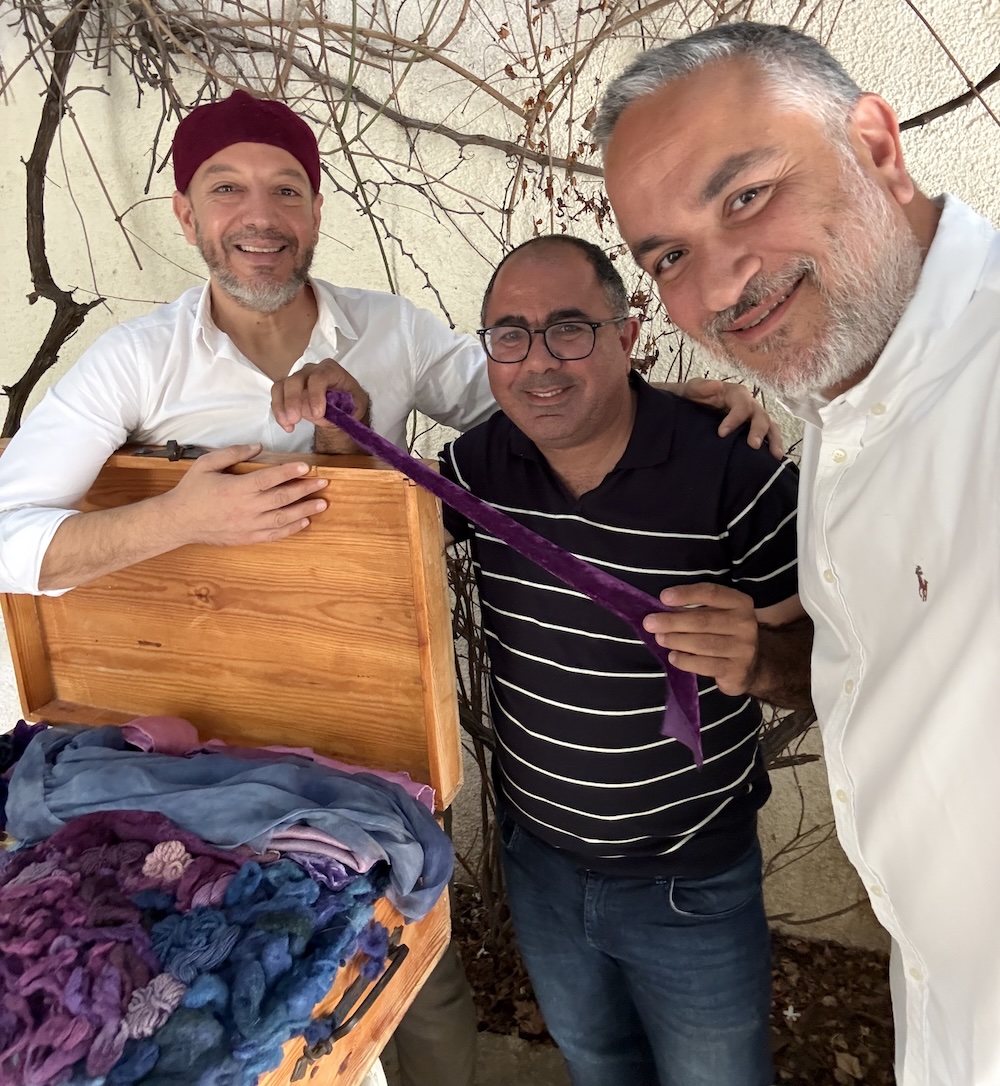
In front of us were reds, violets, magentas, blues, dark purples and shades approaching black. Some were intense and dramatic, others luminous. Some fabrics appeared to carry several colors simultaneously. Mohamed showed us pieces that had been dyed several times over different seasons, with the process extending over years.
This was the moment I began to understand why the ancient world valued this color so highly.
Today, color costs almost nothing. We choose a shade on a computer screen, enter a reference number and reproduce it millions of times. We print purple on paper, manufacture purple plastic and dye kilometres of fabric without thinking about where the color comes from. But imagine the ancient Mediterranean. Imagine seeing one of these extraordinary shades at a time when creating it required collecting marine animals, identifying the right species, extracting tiny glands one by one, understanding fermentation and oxidation, controlling exposure to light, repeatedly purifying the material and finally dyeing precious fabric.
Purple was not merely beautiful. It represented enormous human effort and extraordinary knowledge.
The purification alone is fascinating. Once the material has been extracted and dried under the desired conditions, it must be crushed and cleaned repeatedly. Mohamed showed us how impurities are gradually removed, stage after stage. The pigment becomes finer and increasingly concentrated. It is allowed to rest between stages before being worked again. Eventually, the lighter material can separate from the deepest pigment, which undergoes further purification and maturation.
Some colors mature relatively quickly. The most complicated can take years.
This helps explain the astonishing value. Mohamed spoke about rare purified pigments reaching several thousand euros per gram, with some of the most difficult porphyry shades reaching around four thousand euros per gram. Whether we think in ancient or modern terms, we are talking about an incredibly precious material.
And suddenly the historical stories make sense. You understand why emperors wanted it. You understand why kings wore it. You understand why purple became synonymous with royalty and why access to certain shades was controlled. You understand how a color could become a symbol of political power, religious authority and social status.
For me, however, this encounter had another dimension. It was impossible to listen to Mohamed without thinking about Lebanon.
We Lebanese grow up hearing the word Phoenician. We learn about Tyre and Sidon, the alphabet, navigation, trade and the ships that crossed the Mediterranean. We are taught about a civilization that connected our small coastline to a much larger world. Yet sometimes history becomes so familiar that we stop imagining what it actually looked, smelled and felt like.
Phoenician purple was one of those things for me.
I knew the words. I knew “Tyrian Purple.” I knew that the Phoenicians were famous for it. But standing in Tunisia and seeing real Murex shells, watching Mohamed handle the pigment and looking at fabric dyed through this ancient process transformed the story. For the first time, it stopped being something printed in a schoolbook.
It became real.
There is an old legend about the discovery of Tyrian Purple. The story tells of a dog walking along the shore near Tyre that bit into a Murex shell. When the shell broke, the dog’s mouth became stained with an extraordinary purple color. The beautiful shade attracted attention, and from this accidental encounter supposedly came one of the greatest luxury products of antiquity.
Whether the story is legend, symbolism or a distant memory of how the process was discovered, I love it because thousands of years later Mohamed’s own journey began in an almost strangely similar way. He too was walking beside the Mediterranean. He too noticed a broken shell. He too saw a strange color and wondered what it was.
History somehow repeated itself.
The connection between Tunisia and Lebanon also made the encounter particularly powerful. Mohamed is Tunisian, and his original passion was strongly connected to Carthage. But you cannot explore Carthage deeply without eventually looking east across the Mediterranean toward the Canaanite and Phoenician world and the cities of the Levant. Carthage and Tyre belong to an ancient network that reminds us that the Mediterranean was never simply a body of water separating countries. It was a highway connecting them.
Ships carried people, knowledge, products, ideas and traditions from one shore to another. Lebanon and Tunisia may seem far apart on a modern map, yet through this history they suddenly feel remarkably close.
This is exactly what Marc and I search for during Mission Nature.
We may begin with something extremely small and end up somewhere completely unexpected. In this case, we began with a sea snail. The sea snail led us to chemistry. Chemistry led us to color. Color led us to craftsmanship. Craftsmanship led us to commerce. Commerce led us to Carthage and Tyre, and suddenly we were discussing thousands of years of Mediterranean civilization.
Nature is rarely just nature.
A plant can explain a cuisine. A tree can explain an economy. A landscape can explain why a village exists. And a small mollusk can help explain why an ancient civilization became famous throughout the world.
What Mohamed is doing with Argaman is therefore much more than producing beautiful colors. He is recovering knowledge.
We often speak about heritage preservation by thinking about monuments. We restore an ancient temple, protect an archaeological site, renovate a traditional house or preserve an old church. Those things are essential, but heritage is also knowledge. A technique can disappear just as easily as a building. A recipe can disappear. A craft can disappear. A method of working with a plant, an animal or a natural pigment can disappear. And when nobody remembers how to do it anymore, an entire part of our cultural history is lost.
Mohamed decided that this particular knowledge deserved to live again.
What impressed me was not only the result but the patience required to reach it. We live in a world obsessed with speed. We want immediate answers and standardized results. The Murex doesn’t care about any of that. The pigment reacts to nature. You have to observe it, understand it and give it time. Light matters. Temperature matters. season matters. The animal matters. The mixture matters. Oxidation matters. Fermentation matters. Maturation matters.
You cannot simply press a button.
The ancient craftsmen who mastered this process may not have described their work using today’s scientific vocabulary, but their knowledge was sophisticated. They understood their environment through generations of observation. They knew the sea, the species, the seasons, the reactions and the materials. What we might today separate into biology, chemistry, craftsmanship and art existed for them as one accumulated body of knowledge.
That is perhaps one of the most beautiful lessons of Argaman.
Our ancestors knew much more than we sometimes give them credit for.
Standing there with Marc, watching Mohamed explain every stage with incredible passion, I kept thinking about Tyre. I imagined the ancient coastline. I imagined the shells. I imagined craftsmen doing this work thousands of years ago. I imagined pieces of fabric carrying these colors onto Phoenician ships and traveling across the Mediterranean. I imagined the same shades eventually appearing on kings, emperors and religious leaders.
And then I looked back at the pigment sitting in front of us in Tunisia in 2025.
Almost three thousand years suddenly felt very short.
That is the magic of encounters like this.
They collapse time.
Argaman brought something out of the history books and placed it in our hands. It connected Tunisia to Lebanon, Carthage to Tyre, ancient craftsmen to a modern researcher and the Mediterranean of thousands of years ago to the sea we still look at today.
We arrived to learn about a color.
We left understanding a civilization differently.
And perhaps that is why royal purple remains so captivating. It is beautiful, yes, but its beauty carries a story. Behind every shade is the Mediterranean, the Murex, the light, the seasons, the chemistry, the patience of the craftsman and thousands of years of human history.
A tiny creature from the sea once helped create one of the greatest symbols of power the ancient world had ever known.
Thousands of years later, Mohamed Ghassen Nouira is making sure we don’t forget how it was done.
That is Argaman.
That is the purple of the Phoenicians.
And that is one more extraordinary story connecting Lebanon, Tunisia and our shared Mediterranean heritage.