

















The Bells of Lebanon: Discovering the Craftsmen, Churches and Villages Behind a Forgotten Heritage
There are sounds that become part of a country’s identity. In Lebanon, the sound of church bells echoing across our mountains and valleys is one of them.
But how often do we stop and ask: Who made these bells? How old are they? Where were they cast? And what stories are written on them?
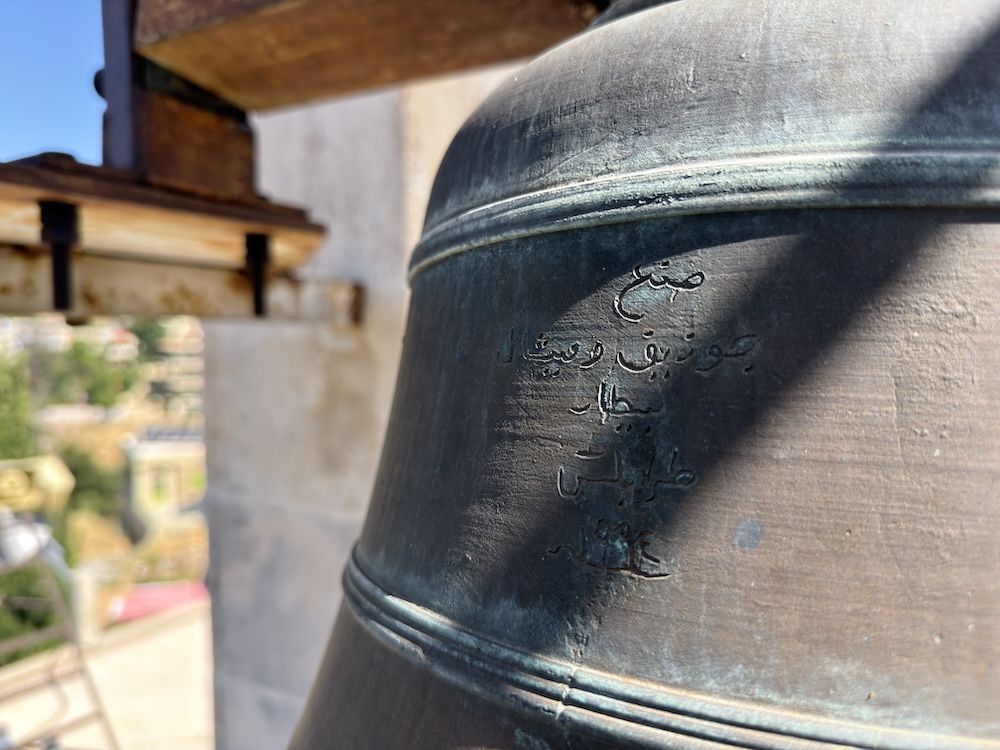
This journey became much more than visiting churches. We climbed bell towers, entered old monasteries, discovered forgotten inscriptions and encountered bells dating back well over a century. Most importantly, we began uncovering the extraordinary story of Lebanese bell making, particularly the craftsmen of Beit Chabeb and Mazraat Yachouh.
From one village to another, every bell revealed another piece of Lebanon’s history.
Beit Chabeb and the Naffah Family: A Lebanese Bell-Making Dynasty
One name kept appearing throughout our journey: Naffah.
Beit Chabeb has an extraordinary connection to the manufacture of church bells in Lebanon, and throughout the episode we encountered bells carrying the names of different generations of the Naffah family.
Among the names and signatures we discovered were:
Mikhail Naffah, Melhem Naffah, Fares Naffah & Brothers, Sleiman Naffah, Youssef Naffah, Chibli Naffah, Habib Naffah, Jamil Youssef Naffah, Amine Naffah, Najib Naffah & Brothers, Georges/Gerges Naffah, Jamil & Sleiman Naffah, and Youssef & Chibli Naffah.
This wasn’t simply one craftsman producing bells. What we discovered was a tradition transmitted through generations.
Some bells still carried clear signatures. Others had inscriptions damaged by time. And in some cases, even when the manufacturer’s name could no longer be read, the decorative patterns and casting style were so characteristic that we could recognize the work as coming from Beit Chabeb.
At Saydet el Ghabeh in Beit Chabeb, we encountered an old bell attributed to Mikhail Naffah and Melhem Naffah. There was no clearly readable manufacturing date, but the bell appeared to be more than a century old.
Another large bell there carried the name Sleiman Naffah and a reference to 1980. Importantly, the discussion suggests that 1980 could correspond to a renovation or intervention rather than necessarily the bell’s original casting date.
Elsewhere we discovered bells signed by Youssef and Chibli Naffah, sons of Habib Naffah; Jamil Youssef Naffah; Amine Naffah; Najib Naffah and Brothers; Fares Naffah and Brothers; Georges Naffah; and other members of this remarkable family.
One of the most exciting discoveries was a bell made by Fares Naffah & Brothers in 1899. During the journey, we described it as possibly the oldest Beit Chabeb bell we had encountered.
Another bell by Youssef and Chibli, sons of Habib Naffah, was dated 1939.
A bell by Amine Naffah carried the date 1951.
Another, made by Jamil Youssef Naffah, was dated 1963.
We also encountered a bell made by Jamil and Sleiman Naffah dated 1971.
There was another old bell carrying the name Sleiman Naffah, with the date appearing to be either 1921 or 1931. The inscription was not clear enough in the material to establish which year with certainty.
At another stop, we found a bell by Youssef Naffah, son of Sleiman, adding another connection to the family’s succession from one generation to the next.
And toward the end of the journey, another large bell carried the name Habib Naffah & Brothers.
Piece by piece, the bells themselves began telling the story of an entire Lebanese craft dynasty.
Mazraat Yachouh and Another Tradition of Lebanese Bell Making
Beit Chabeb wasn’t the only Lebanese center represented in the bells we discovered.
Mazraat Yachouh also appeared repeatedly.
One bell was clearly identified as the work of Antoine/Anton Mounem & Sons of Mazraat Yachouh, dating to 1950.
Another mountain-village bell was also attributed to Antoine Mounem of Mazraat Yachouh, although its manufacturing date could not be established with enough confidence from the recording.
Finding bells from both Beit Chabeb and Mazraat Yachouh demonstrated that Lebanon once possessed a much richer local tradition of bell casting than many people today probably realize.
An Extraordinary French Bell from 1883
Not every bell we encountered was Lebanese.
At Qornet Chehwan, around Mar Youssef and the summer seat of the bishopric, we discovered one of the episode’s most historically interesting bells.
The bell was French, dated 1883, and described as a gift from France to Monsignor Zoghbi. It also carried the number 824.
The automatic transcription did not preserve the French manufacturer’s name reliably enough for me to publish it as fact, but the date and French origin make this bell particularly significant.
At Qornet Chehwan we also encountered a very large bell weighing approximately 206 kilograms. Its exact manufacturer and date could not be established from the inscription, although its characteristics suggested a connection to Beit Chabeb.
A Bell Dating to 1856
Perhaps the most remarkable date encountered during the journey was 1856.
At a private church/cemetery, we discovered a bell carrying that date, decorated with Christian imagery including a cross and the Virgin Mary.
Its manufacturer could not be identified from the available inscription.
If 1856 is indeed its manufacturing date, it makes this one of the oldest clearly dated bells encountered during our journey.
Imagine what Lebanon looked like when that bell first rang.
Generation after generation has heard its sound. Political systems changed, villages expanded, roads were built, wars came and went, families emigrated and returned—and the bell remained.
Other Bells and Discoveries Along the Way
We encountered many more bells for which only part of their story could be reconstructed.
One large decorated bell carried the date 1978, although its manufacturer wasn’t clearly established.
At Mar Shalita, we encountered a bell made by Fares Naffah & Brothers. The church itself was associated with the date 1844, but it is important not to confuse the age of the church with the manufacturing date of the bell.
At the Prophet Daniel Church, we found another very old bell. Its origin couldn’t be established with certainty. During the discussion, possibilities included Beit Chabeb, Mazraat Yachouh or Tripoli.
Another bell was identified as Italian-made, reminding us that Lebanese churches also imported bells from Europe.
We encountered another bell by Youssef and Chibli Naffah, another by Najib Naffah & Brothers, and several bells whose signatures or dates had become too difficult to read after decades of exposure.
Some could still be recognized by their decorative bands and casting characteristics.
And this is part of what makes documenting them today so important.
The Manufacturing Dates We Found
Among the clearest bell-manufacturing dates encountered during the journey were:
1856 – 1883 – 1899 – 1939 – 1950 – 1951 – 1963 – 1971 – 1978
The year 1980 also appears on a bell associated with Sleiman Naffah, although it may indicate a renovation rather than the original casting.
There are also uncertain dates—including 1921 or 1931, and possibly 1908—which require closer inspection of the actual bells before they should be entered into a definitive historical record.
This distinction is important because many dates appear on churches, monasteries and inscriptions during the journey. A church’s construction date is not necessarily the manufacturing date of its bell.
The Villages and Places Along Our Bell Journey
Our search took us through a remarkable part of Lebanon and into churches, monasteries and bell towers that most people normally see only from below.
Among the locations appearing throughout the journey were:
Beit Chabeb, including Saydet el Ghabeh; Qornet Chehwan, including Mar Youssef and the bishopric; Mazraat Yachouh; Antelias; Deir Mar Gerges; Mar Shalita; the Prophet Daniel Church; Farsh Laymoun/Farsh Limon; and other mountain villages and religious sites encountered along the route.
The journey also takes us through or discusses areas connected with Bcharre, Jebbet Bcharre, Batroun and the Qadisha region.
More Than Pieces of Bronze
What fascinated me most during this journey wasn’t simply finding an old date.
Every bell is a historical document.
The manufacturer’s signature tells us about a Lebanese craftsman. The date connects us to a particular generation. The decoration tells us something about religious and artistic traditions. The church tells us about the community that commissioned it. Even the size and weight of a bell reveal something about the ambitions and resources of the village that installed it.
And then there is the sound.
For more than a century, some of these bells have announced weddings, funerals, feast days, Sunday Mass, celebrations, tragedies and ordinary mornings in Lebanese villages.
They were there before our grandparents.
Some were there before our great-grandparents.
A Heritage Worth Documenting
This journey made me realize that Lebanon’s bells deserve much more attention.
There is potentially an entire undocumented history sitting above our heads in church towers across the country.
Who were Lebanon’s bell makers?
How many bells did the Naffah family cast?
How far across Lebanon—and perhaps outside Lebanon—did bells from Beit Chabeb travel?
How many bells were produced in Mazraat Yachouh?
Which villages still possess their original 19th-century bells?
What happened to the workshops, molds and knowledge of these craftsmen?
And could there be even older Lebanese-made bells waiting for us in another forgotten bell tower?
These are questions worth asking.
Because Lebanon’s heritage isn’t found only in museums.
Sometimes you have to climb a narrow staircase, push open an old wooden door, look above you—and find a piece of Lebanese history that has been ringing for more than a hundred years.
This is Lebanon. These are our villages, our craftsmen, our churches and our stories. And the more we explore, the more we realize how much there is still left to discover.