












For almost fifteen years, I have been traveling across Lebanon, discovering villages, meeting people, entering kitchens, sitting around tables and listening to stories. Food has always been part of the journey, but I have learned that the most important part is rarely the plate itself. It is the person behind it, the place it comes from, the memories attached to it and the people who will continue making it after us.
Over the years, I started noticing something that worried me. Some of the greatest recipes I have tasted in Lebanon don’t exist in cookbooks. They aren’t written anywhere. There are no measurements, no exact temperatures and sometimes not even a name for the technique being used. A mother learned it from her mother, who learned it from hers. She cooks by feeling, by smelling, by touching. She knows when the dough needs more water just by looking at it. She knows when the sauce is ready from its color. Ask her how much she added and she’ll probably tell you, “شوي” — a little.
This is a beautiful part of Lebanese cooking, but it also makes it fragile. When that person is no longer cooking, what happens to everything she knows?
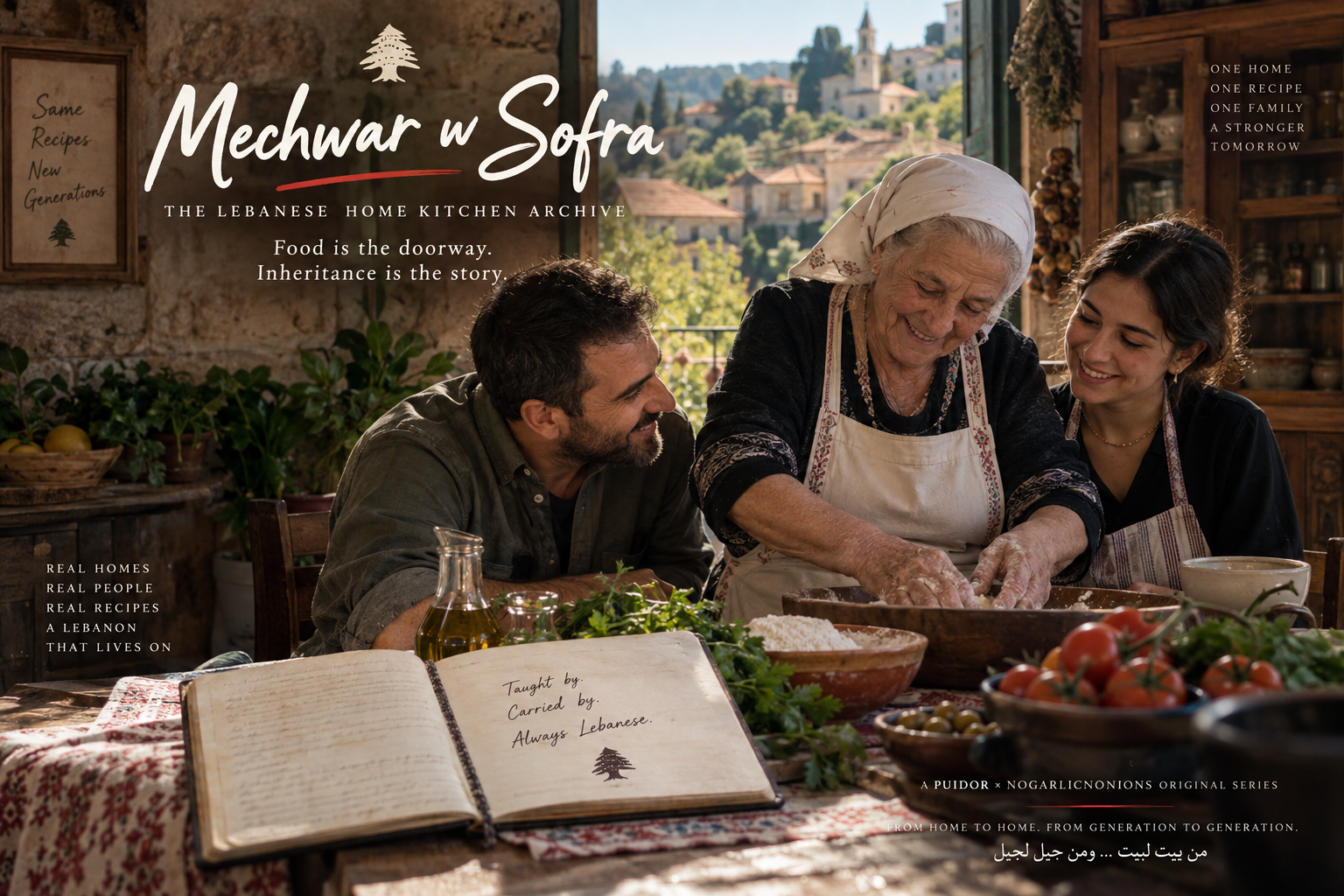
This question became the starting point of our newest project, Mechwar w Sofra — The Lebanese Home Kitchen Archive. Its philosophy can be summarized in one sentence that has guided the project from the beginning: food is the doorway; inheritance is the story. Every story we document ultimately asks what this woman knows that could disappear, and who will carry that knowledge next.
I didn’t want to make another cooking show. I wanted to create something that feels much closer to what I’ve been doing around Lebanon for years, but with a purpose that can live long after the episode has been watched. I want us to enter real Lebanese homes and preserve what happens inside them. The recipe, of course, but also the hands making it, the old kitchen tool that has been there for fifty years, the local expression used to describe a technique, the story behind the dish and the family waiting to eat it.
And because this is Lebanon, we cannot simply arrive at a house, cook and leave. We need a mechwar.
Chef Jean Barbour and I will travel together from one part of Lebanon to another. We’ll arrive in the village, walk its streets, meet its people and understand where we are. We might visit a farmer, a butcher, a baker or an artisan. We might go searching for an ingredient we need for lunch. Sometimes we’ll discover a place we didn’t know existed. The village isn’t there to provide beautiful shots between cooking scenes. It is part of the story. Lebanon is a character, not a backdrop.
Eventually, that mechwar brings us to someone’s front door.
We enter her house and, most importantly, we enter her kitchen. Not a studio pretending to be a Lebanese kitchen. Not a set dressed for television. Her real kitchen, with the pots she uses every day, the ingredients she buys, the table her family sits around and all the imperfections that make a home feel like a home.
There, Jean and I have very different roles. I want to listen, discover the family and understand the memories surrounding the food. Jean has another challenge. As a chef, he has to watch carefully and understand the things this woman does instinctively. He needs to see the gesture that no written recipe can explain. The way she shapes something between her fingers. The moment she decides the dough is ready. The texture she is looking for. The tiny details she may not even realize she knows.
We don’t want to correct her recipe or turn it into our version. We want to preserve her way first. Then Jean can help us translate that intuitive knowledge into a tested recipe that another person could reproduce without erasing the voice of the woman who taught it.
As she cooks, another story starts appearing. Who taught her? Why does she still prepare this dish? Who loves eating it? When does the family ask for it? What happened around this table over the years?
This is where a cooking episode becomes a human story.
The women we’re meeting come from very different places and very different lives. In Jbeil, for example, Milia Salameh carries more than forty years of cooking experience, and her story brings her together in the kitchen with her daughter-in-law, Chef Giselle. Two generations, two perspectives, one family and knowledge moving from one to another. In Baalbeck, Mona Kanaan carries old-style Baalbeck cooking and traditional dishes that reflect the culinary identity of her region. In Saghbine, Hiyam Joubran’s food connects several generations of the same family around recipes and memories that belong to the village.
Other journeys will take us through Hasroun, Niha, Maasser el Chouf, Saida, Tripoli and beyond. One woman may have spent her life feeding her family. Another may have turned cooking into a livelihood. Another may be protecting a recipe almost nobody prepares anymore. Their stories don’t need to be identical, because Lebanon isn’t identical. The idea is for every home to reveal another piece of the country.
And eventually, after the driving, discovering, talking, chopping, mixing and cooking, everything leads to the sofra.
For me, this is where Lebanese food really makes sense.
An empty table slowly fills with plates. Then the people arrive. Someone brings another chair. Someone cuts the bread. Somebody tastes from the plate before everyone has sat down. The conversations start. People laugh. Memories appear. Someone tells us that her mother used to prepare the dish differently. Someone else insists this is the only correct way to eat it.
Nothing needs to be scripted because this is what Lebanese families already do.
The structure of the series deliberately gives the family meal room to breathe. We want the genuine reactions, conversations, humor and emotional meaning of the meal to emerge naturally. The table starts empty and ends alive with people, because ultimately this isn’t a story about food sitting beautifully on a plate. It’s about why we cook in the first place.
But there is one moment that I believe will give Mechwar w Sofra its real meaning.
Before we leave, we ask who will carry this knowledge next.
It might be a daughter or a son, a granddaughter, a daughter-in-law or even a neighbor. Someone learns an essential part of the recipe directly from the woman whose story we are documenting. Not theoretically. They stand beside her and do it.
We are also creating an Archive Book that will travel with us from home to home. Each woman will leave her name, her village, her recipe and a handwritten message inside it. The person receiving the knowledge will become part of that page too. Taught by. Carried by. With every episode, another page is filled and another piece of Lebanese culinary memory is preserved.
That book represents what I ultimately want this project to become.
Not simply a season of videos, but a living Lebanese Home Kitchen Archive.
We want to preserve the recipes, certainly, but also portraits, voices, local words, techniques, family histories, inherited kitchen objects and the stories connecting food to a particular home and village. The project is being designed from the beginning so this material can eventually live beyond the episodes themselves, through an archive, a book, contributions from the diaspora and other ways of allowing people to add to this collective memory.
Puidor is joining NoGarlicNoOnions on this journey as the preservation partner behind the project. It was important to us from the beginning that its presence remain natural. The products belong where they would normally belong: inside the cooking and inside real kitchens. The women and their families remain the protagonists.
After all these years of filming Lebanon, I think more and more about the difference between creating content and creating a record.
A video can get views and disappear from people’s feeds a few days later. But imagine if, while making those videos, we could also preserve something that might otherwise be lost.
Imagine being able to watch a Lebanese woman twenty or thirty years from now and see exactly how she moved her hands when she made her kibbeh. To hear her voice explaining something in the dialect of her village. To know who taught her. To see the kitchen where she cooked for her children. To read the sentence she wrote by hand for the generation coming after her.
That, for me, is much more powerful than another recipe video.
There are thousands of homes across Lebanon carrying stories like these. Thousands of recipes that exist mostly in people’s memories. Thousands of mothers and grandmothers who probably don’t realize that what they do every day is part of our cultural heritage.
We cannot document all of them at once.
So we’ll start with one road, one village, one front door, one kitchen, one family and one sofra.
Then we’ll move to the next.
Mechwar w Sofra is our journey to preserve Lebanon’s home kitchen, one story at a time.