
















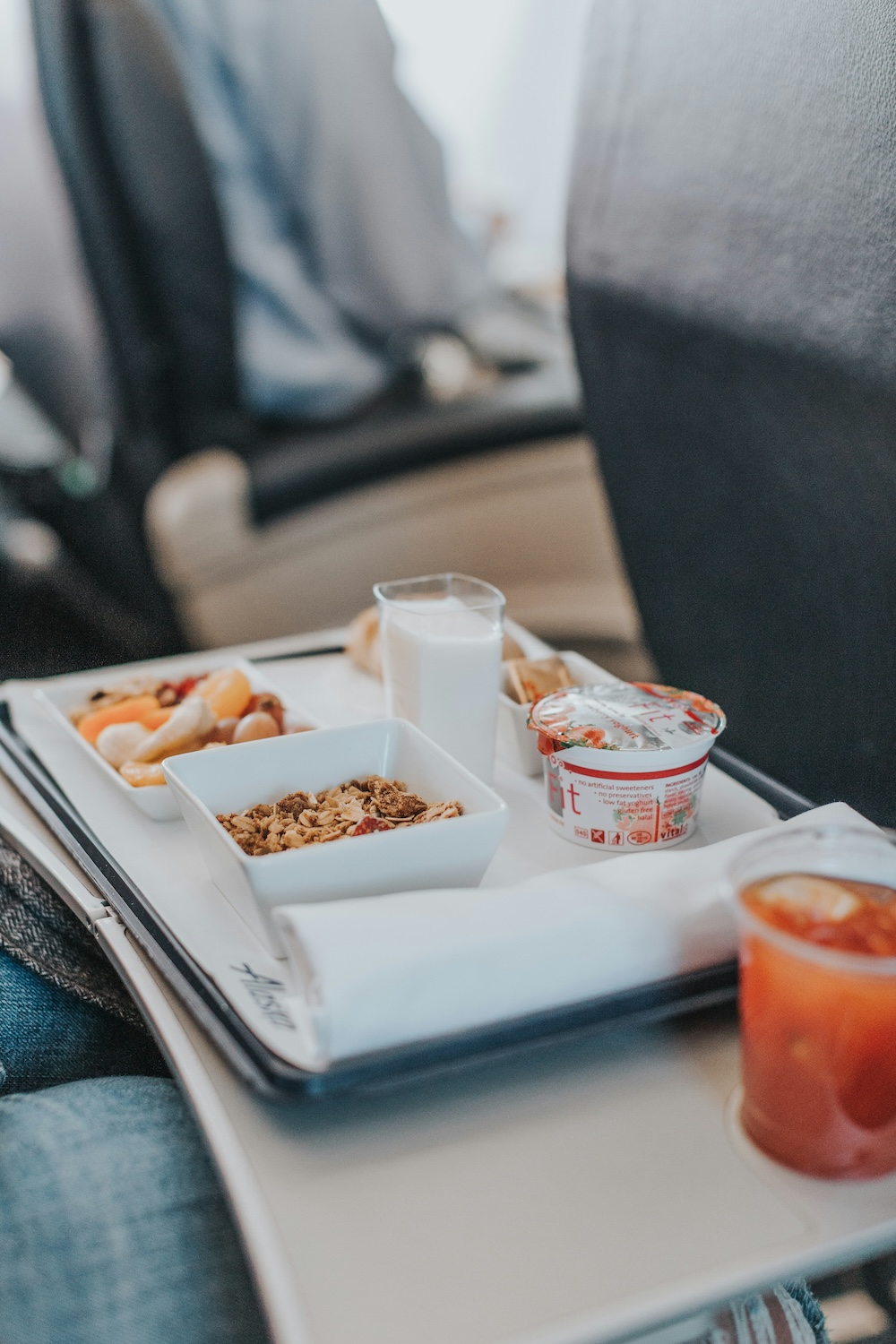
You're cruising at 35,000 feet. The meal service arrives. You take a bite of something that looked perfectly decent in the photo. It tastes like nothing. The coffee is flat. The tomato juice, somehow, is not bad. And the ginger ale? Oddly satisfying.
This isn't your imagination, and it isn't the airline's kitchen. Something measurable is happening to your senses the moment you board. Here's what the science actually says, and why understanding it changes how you think about eating and drinking in the air.
1. Dry Cabin Air Dulls Your Smell (and Smell Is Most of What You Taste)
This is the root cause, and it explains nearly everything else on this list.
Flavor perception is not purely taste. Roughly 70-80% of what we experience as "taste" is actually smell. Your olfactory system, the network of receptors at the back of your nasal passage, processes aromatic compounds from food and sends signals to your brain that your tongue alone never could. Without it, even a complex dish collapses into a few basic sensations: sweet, salty, sour, bitter, umami.
Research conducted by the Fraunhofer Institute for Building Physics found that low cabin humidity and reduced air pressure can decrease smell sensitivity by up to 30%. At altitude, the mucous membranes lining your nasal passages dry out, causing the same dryness behind a scratchy throat and dehydrated skin, and your olfactory receptors simply stop firing at full capacity.
This is the same mechanism that makes food taste like nothing when you have a head cold. The nose is blocked, the smell is gone, the flavor vanishes. On a plane, the cabin air does it without you noticing.
"Smell sensitivity can drop by up to 30% at altitude due to low humidity and reduced air pressure." Fraunhofer Institute for Building Physics
Lufthansa took this research seriously enough to commission a dedicated study and reformulate their in-flight menus around it, leaning into bolder flavors, more salt, and higher concentrations of umami-rich ingredients to compensate for what altitude takes away.
The logical fix is to keep your nasal passages from drying out in the first place. Staying hydrated helps. A saline nasal spray helps. And breathing humidified air throughout the flight, rather than the 4-7% humidity of standard cabin air, helps most of all. It's the core idea behind Kuvola: if the air you breathe retains proper moisture, your olfactory system stays functional, and the food you eat at 35,000 feet actually tastes like something.
2. Your Taste Buds Need More Salt and Sugar to Register the Same Flavor
Even setting smell aside, altitude changes how your taste buds respond to basic flavors.
A 2010 study commissioned by Lufthansa and conducted at a specialized pressure-simulation facility, a sealed aircraft-sized chamber built by the Fraunhofer Institute, tested the taste perceptions of 140 participants under normal conditions versus simulated cabin conditions. The results were striking. Sensitivity to sweet and salty tastes dropped by roughly 30% at simulated altitude. Sourness, bitterness, and spiciness remained largely intact.
What this means practically: a dish that's properly seasoned at sea level will taste under-seasoned in the air. Airlines know this, which is why in-flight food often contains significantly more salt and sugar than its ground-level equivalent. They're not cutting corners. They're compensating.
"Sensitivity to sweet and salty tastes dropped by approximately 30% in simulated cabin conditions." Lufthansa / Fraunhofer Institute study, 2010
This also explains why certain condiments and sauces, things with acidity, heat, or strong umami, perform better in the air. Your perception of those flavor dimensions is far less affected by altitude than your perception of salt and sweetness.
3. Why Ginger Ale Tastes So Good on a Plane
Ask frequent flyers what they drink on planes and ginger ale comes up more than you'd expect, even from people who never order it on the ground. There's a real reason for this.
Ginger ale benefits from altitude in a few different ways simultaneously. Its primary flavor compounds, the sharpness of ginger, the bite of carbonation, the subtle spice, fall into the categories that altitude doesn't significantly suppress. Bitterness and sourness remain largely intact at cabin pressure, which means ginger ale tastes closer to itself than almost anything else on the drinks cart.
The carbonation plays a role too. At lower cabin pressure, carbonated drinks may feel slightly less fizzy, but the sensation of carbonation itself, the slight acidity and the tingle on the palate, provides a physical sensory feedback that doesn't depend on smell the way most flavors do.
And ginger has a genuine physiological benefit at altitude. Ginger is a well-documented anti-nausea remedy. The mild queasiness some passengers feel, caused by turbulence, cabin pressure changes, or the mild hypoxia that comes with reduced oxygen at altitude, is something ginger actively helps with.
So the ginger ale craving isn't nostalgia or habit. It's your body finding something that actually works in the environment you're in.
4. Tomato Juice: The In-Flight Anomaly
Tomato juice is one of the most-ordered drinks in the air, and one of the least-ordered on the ground. Lufthansa alone serves around 1.8 million liters of tomato juice per year, roughly the same volume as beer.
The reason is the same science applied in reverse. Tomato juice is naturally high in umami, the savory and complex flavor dimension driven by glutamates. Umami perception is one of the few taste categories that isn't significantly blunted by altitude. In fact, some research suggests that umami may be slightly enhanced in low-pressure environments.
Combined with the mild acidity and the sensory weight of a thick liquid, tomato juice delivers flavor at altitude when almost nothing else does. It's the rare drink that the environment actually works in favor of, not against.
5. What You Can Do About It
Some of this is simply the physics of the environment. But a few adjustments make a meaningful difference.
- Order umami-rich options. Tomato-based dishes, broths, aged cheeses, and anything with a savory depth will hold up better than sweet or delicately flavored foods.
- Skip the alcohol, especially wine. Wine is complex and aromatic, precisely the kind of drink that altitude flattens most. It's also dehydrating, which compounds the smell-suppression problem. Save the good bottle for the ground.
- Stay hydrated throughout the flight. Dryness is the mechanism. Drink water consistently, use a nasal spray, and keep your respiratory system from drying out. A Kuvola humidifier mask addresses this directly. By recycling moisture from your own breath, it keeps the air entering your nasal passages humid and helps preserve olfactory sensitivity for the duration of the flight.
- Order the ginger ale. It's genuinely one of the better choices at altitude, and now you know exactly why.
- Eat before you board if the food matters to you. A meal on the ground, tasted properly, will always outperform its in-flight equivalent.
The Takeaway
The next time an in-flight meal disappoints you, the kitchen isn't entirely to blame. Dry cabin air has blunted your sense of smell. Reduced pressure has dulled your sensitivity to salt and sweetness. And the gap between what food tastes like on the ground and what it tastes like in the air is wide enough that major airlines spend significant resources trying to bridge it.
Understanding the mechanism doesn't make the meal better, but it does point to a solution. Keep your nasal passages hydrated, protect your olfactory system, and choose what you eat and drink with the environment in mind. Your palate will thank you on arrival.