













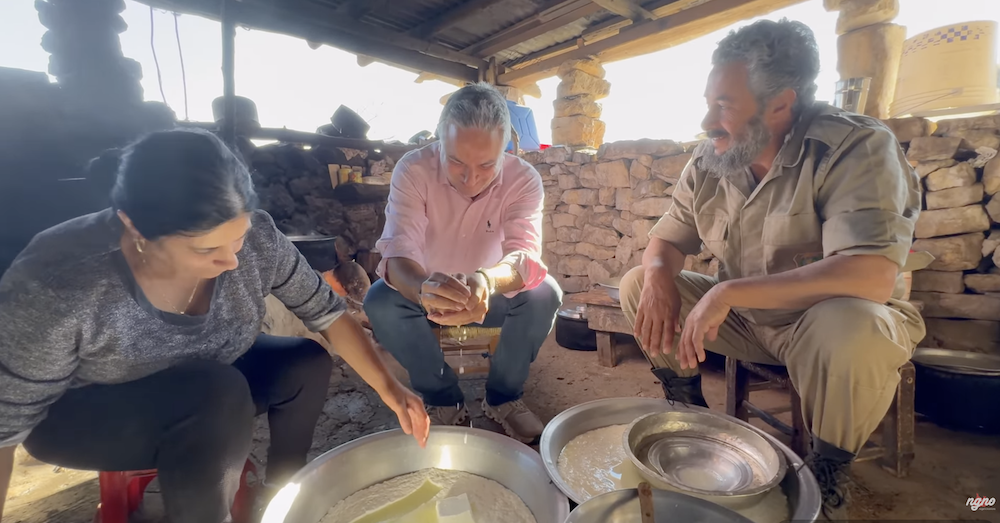
High in the mountains above Ehden, at around 1,500 meters above sea level, we traveled deep into Btelaya for an experience that goes far beyond food. After more than an hour of difficult off-road driving, we reached a shepherd’s home under the stars, where we spent the night with the family before waking up to document one of Lebanon’s most fascinating and endangered food traditions: Jebneh Darfieh, the traditional Lebanese goat cheese aged inside a goatskin.
This episode is not simply about making cheese. It is about understanding the entire world that exists behind it.
Our journey begins with the shepherds themselves. More than one hundred goats leave in the morning to graze across the mountain, spending much of the day moving through this extraordinary landscape before returning in the evening. Life here follows the animals, the seasons, the weather and the land.
Fresh goat’s milk becomes the starting point for everything we taste: local white cheese, labneh, arisheh and, ultimately, Darfieh. We follow the cheesemaking process from the moment the milk is prepared and coagulated, through the separation of the curds and whey, to the making of fresh baladi cheese. Nothing is wasted. The remaining whey is heated again and enriched with milk to produce arisheh, which later plays an essential role in the maturation of Darfieh.
Then comes the part that makes this cheese truly exceptional.
Darfieh is traditionally matured inside a carefully prepared goat skin. The skin must be removed without damaging or puncturing it, meticulously cleaned, dried and prepared before it can hold the cheese. Inside, layers of fresh cheese are combined with salted arisheh. The skin is then tightly sealed to prevent air from entering, and the cheese is left to mature for approximately three weeks to a month.
The process cannot be rushed.
Every piece of Darfieh represents far more work than what we see when it finally reaches the table: raising the goats, grazing them in the mountains, milking, heating the milk, making and draining the cheese, preparing the arisheh, salting, turning, filling and sealing the goatskin, waiting for maturation and finally transporting the finished cheese down difficult mountain roads.
We also discover that this knowledge has survived through generations. With Youssef Mouroun, we trace a family tradition spanning four generations. The techniques he practices today were not learned from manuals or industrial cheesemaking courses; they were passed from grandparents to parents and children through years of watching, working and living on this land.
Even when modern methods could make production faster or cheaper, the family continues to preserve traditional practices, including cooking over wood fire. Their goal is not merely to produce cheese, but to protect a way of doing things that connects the finished product to its history and its place of origin.
The episode also takes us beyond cheesemaking and into the extraordinary ecosystem surrounding Btelaya and Ehden. We walk among Lebanon’s cedars, junipers, wild apple trees and mountain vegetation, pick cherries and discover vegetables grown directly on the land. We talk about biodiversity, sustainable grazing and why preserving traditional agriculture can also help protect the mountain environment.
Youssef is now trying to pass this relationship with the land to another generation. A small accommodation project allows visitors to sleep in the mountains, wake up surrounded by nature and eat food produced only meters away: vegetables from the garden, goat-milk products and, of course, Darfieh.
We even take time to plant new cedar trees—a symbolic reminder that documenting heritage is not only about looking backward. It is also about making sure something remains for those who come after us.
The day eventually brings everyone back around the table: freshly picked vegetables, potatoes cooked over wood fire, homemade dairy products, coffee, arak, generous hospitality and the finished Darfieh cheese we came all this way to understand.
This documentary is our attempt to preserve more than a recipe.
It documents a Lebanese craft, a family legacy, a mountain ecosystem and a way of life that could easily disappear if the people keeping it alive are not supported. Darfieh deserves to be understood as more than simply another Lebanese cheese. Its identity comes from its goats, its shepherds, its landscape, its traditional goatskin maturation and generations of accumulated knowledge.
In Btelaya, cheese is not simply made.
It is raised, milked, heated, drained, salted, aged and carried down from the mountain. It is the taste of the land itself—and a piece of Lebanese heritage worth protecting.