

















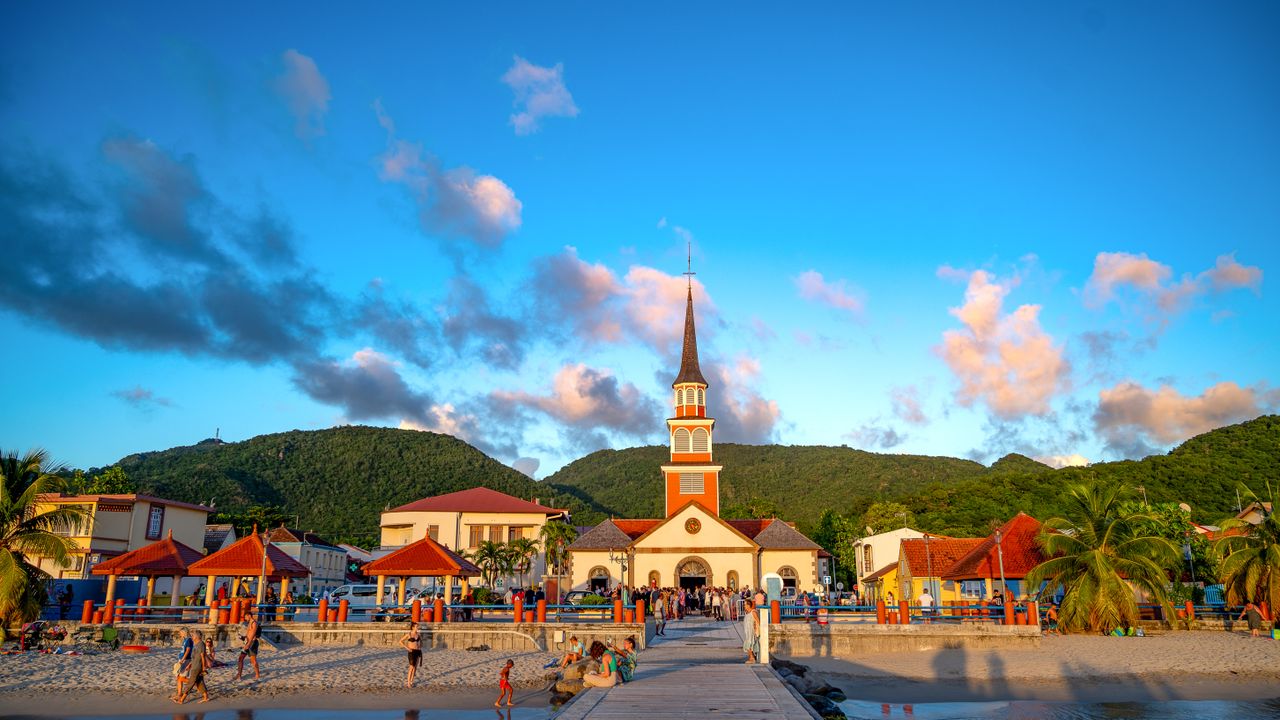
Most people meet Martinique through a resort buffet, and that's a shame. The island's real cooking lives in places a tour bus never stops: a roadside grill in the north, a family-run lolo on a southern beach, a rum distillery at the end of a sugarcane track. The island is only about 70 km long, but the food changes noticeably from one end to the other.
Winter is the best time to taste it. From December to April the weather is dry and warm, the cane harvest starts in February, and December brings chanté Nwel, the island's Christmas carol gatherings. Neighbours sing until late over ham, pigeon pea stew and glasses of shrubb, a rum liqueur steeped with orange peel.
The catch is getting around. Buses are infrequent outside Fort-de-France, taxis are expensive, and the best stops are scattered across hills and side roads. A car lets you eat on your own schedule. Here is a route that covers the island in four to five days.
Day 1: Fort-de-France and the Grand Marché
Start in the capital, ideally on a weekday morning. The covered Grand Marché is where locals buy spices, and it's a good place to learn what you'll be eating for the rest of the trip. Look for colombo powder, the island's curry blend, and bois d'Inde, a leaf that smells like clove and cinnamon at once. Vendors are usually happy to explain what goes into what.
For lunch, find a small canteen near the market and order colombo de poulet, chicken slow-cooked in that spice mix. Add a portion of acras, salt cod fritters, and a glass of fresh passion fruit or soursop juice. In the evening, try a ti-punch: white rhum agricole, lime and cane syrup. Locals mix their own at the table, so you control the strength.
Day 2: The North, Rum and the Route de la Trace
The north is where Martinique's rum comes from, and the drive is half the reason to go. Take the Route de la Trace (N3) through the rainforest toward Morne-Rouge. It's narrow and winding, with tree ferns overhead, so allow more time than the map suggests.
Martinique's rhum agricole is made from fresh cane juice rather than molasses, and it has its own AOC, the only one for rum in France. A few distilleries are worth a stop:
- Depaz, at the foot of Mount Pelée near Saint-Pierre, with a tasting room in an old plantation setting
- Neisson, in Le Carbet, a small family distillery
- JM, in Macouba at the far north, reached by a steep road through cane fields
Take turns behind the wheel or keep tastings small. In Saint-Pierre, the town destroyed by the 1902 eruption, look for a seafront restaurant serving blaff, fish poached in a lime and herb broth. It's simple, and it tastes very fresh.
Day 3: The Atlantic Coast and the Fonds Blancs
Cross to the Atlantic side and head for Le François and Le Robert. Offshore, shallow sandbanks called fonds blancs sit in turquoise water. Boat operators run trips out, and many include a ti-punch standing waist-deep in the sea.
On land, visit Habitation Clément, a restored estate with gardens, rum cellars and a sculpture park. Back in Le François, order chatrou, octopus stewed in tomato and spices, or a court-bouillon de poisson. Both are best where the fishing boats come in.
Day 4 and 5: The South, Beaches and Lolos
The south is drier, sunnier and full of beaches. Base yourself around Sainte-Anne or Sainte-Luce. A lolo is a small beach shack or family kitchen, often with plastic chairs and a handwritten menu. This is where you'll eat best for the least money.
Order grilled fish of the day with sauce chien, a sharp mix of herbs, lime, onion and chilli. Try boudin créole, a spicy blood sausage, and féroce d'avocat, mashed avocado with salt cod and cassava flour. Finish with a sorbet coco made in a hand-cranked wooden churn if you see one.
On your last afternoon, drive to Grande Anse des Salines, the island's best-known beach. Pick up a cooler of snacks on the way and stay for sunset. The Trois-Rivières distillery in Sainte-Luce is a good final tasting before you drop off the car.
Practical Tips for Driving and Eating in Martinique
- Book the car early. December to April is high season, and the good-value cars go first. Most visitors arrive at Aimé Césaire International Airport in Le Lamentin, so picking up a car rental in Martinique right at arrivals saves a taxi ride and gets you on the road the same day.
- Choose a small car. Northern roads are steep and narrow, and parking in Fort-de-France and Saint-Pierre is tight. A compact handles both easily.
- Know the rules. Martinique is part of France, so you drive on the right and French road rules apply. A licence from the EU, UK, US or Canada is generally accepted for short stays.
- Avoid rush hour around the capital. Traffic around Fort-de-France and Le Lamentin builds up on weekday mornings and late afternoons. Plan market visits early and long drives for the middle of the day.
- Carry some cash. Many lolos and roadside stands don't take cards, and the euro is the local currency.
- Eat lunch as the main meal. Many small kitchens cook for midday and close early. If a place looks busy with locals at 12:30, that's your stop.
Taste the Island at Your Own Pace
Martinique is small enough to drive around in a few days, yet each stretch of coast cooks differently. Spices in Fort-de-France, rum and broth in the north, octopus on the Atlantic side, grilled fish and sorbet coco in the south. With your own wheels, whether from a local agency or an international provider like Addcar Rental, you can linger where the food is good, skip what doesn't appeal and follow a tip from the person at the next table. That's how most of the island's best meals get found.